

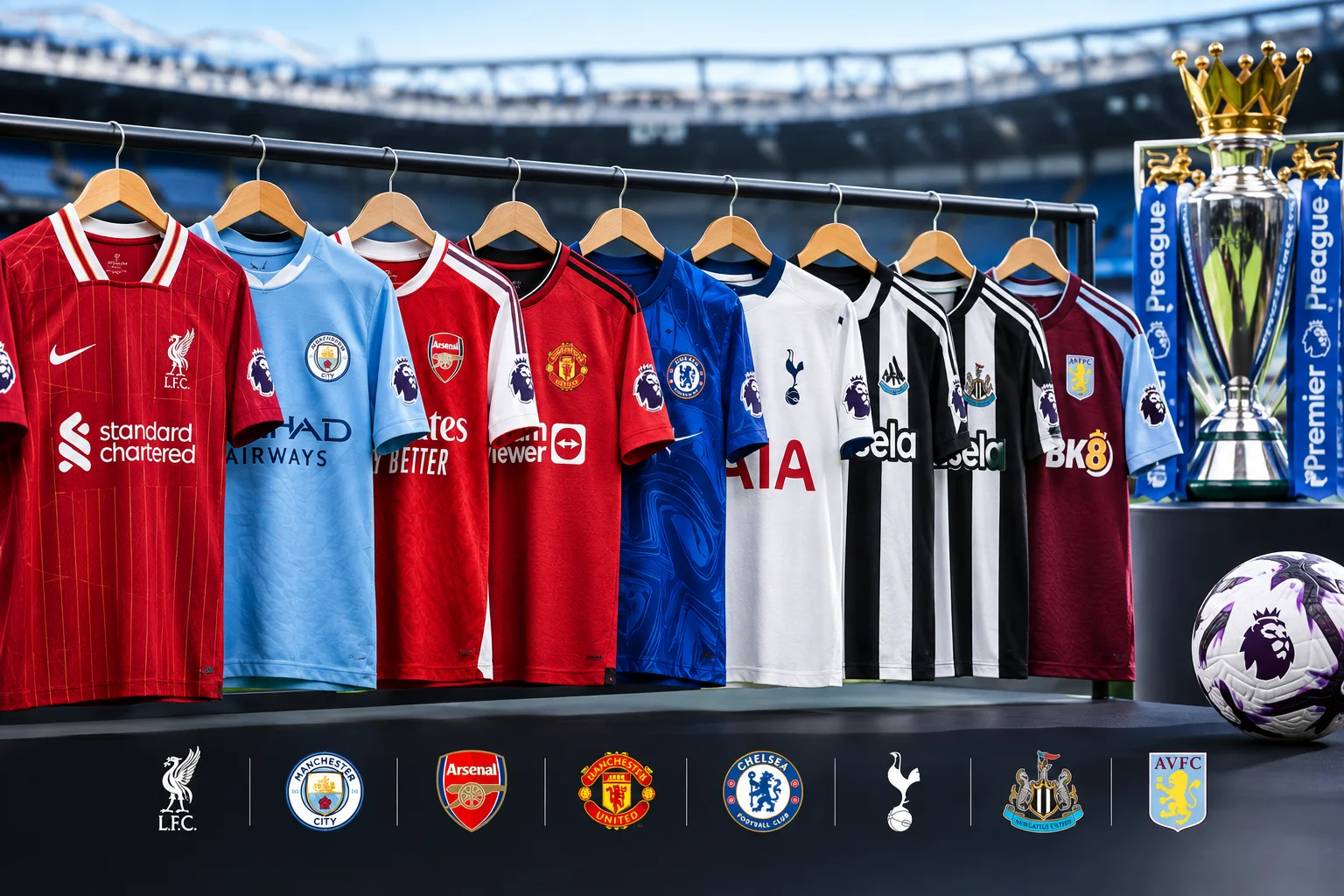
Twenty clubs release at least three kits each summer, which puts around sixty new shirts into the market inside a few weeks. Almost all coverage of them treats each club in isolation, ranking designs against each other and moving on.
Comparing the ranges rather than the individual shirts is more useful, because the structural differences between clubs are consistent year to year and they tell you where value reliably sits.
Why do so many kits look related?
Because most are built on shared templates.
Manufacturers develop a small number of base designs each season and apply club colours, crests and trim to them. That is why shirts from different clubs frequently share a collar shape, a sleeve construction or a panel arrangement despite looking nothing alike in colour.
This is not a shortcut so much as how the fabric technology gets tested and refined at scale. But it has a practical consequence worth knowing: if you know your size in one club’s shirt from a given manufacturer and season, that knowledge usually transfers to other clubs on the same template. Useful when buying a second shirt from a different club.
How do production volumes differ between clubs?
Enormously, and it is the single biggest structural difference across the league.
The largest clubs sell shirts internationally in quantities that smaller clubs cannot approach. That means deep stock across every size, availability lasting well into the following year, and reductions that are real but not dramatic because demand persists.
Smaller clubs produce far fewer. Stock is thinner, popular sizes sell through faster, and the window for buying a particular season is narrower. Anyone shopping across premier league kits from different clubs will notice this immediately: the same strategy does not work everywhere.
Where is design risk actually taken?
Almost entirely in away and third kits, across every club in the league.
Home shirts are commercially constrained. The colour is fixed, the template is shared, and change between seasons is confined to collar, trim and small detail. Radical redesign of a home shirt risks the people most likely to buy one, so it rarely happens.
Away kits carry a smaller commercial downside, so that is where clubs use unusual colours, revive old designs or take a genuine swing. Third kits push further still, existing partly for European competition and partly because a third shirt can be sold.
The practical upshot is consistent league wide: if you want a shirt that stays distinctive, look at away and third kits regardless of which club you support.
Does the sponsor affect longevity?
More than most people expect, though nobody buys a shirt for the sponsor.
Sponsorship deals run in blocks of several years. A short lived deal pins a shirt to a narrow window and makes it instantly datable, which is exactly what keeps a shirt recognisable decades later. Long running deals produce a stack of shirts that blur together and become difficult to place even for committed supporters.
This applies uniformly across the league, and it is the most reliable single predictor of whether a given season’s shirt will still be interesting in fifteen years.
How should you compare quality between clubs?
The checks do not change, which is the useful part.
Crest attachment, stitching density at the hem and cuffs, and fabric texture in close up work identically regardless of club, manufacturer or price bracket. Learning them once covers every purchase you will make.
What does vary by club is which faults are most visible. White kits expose fabric weight and opacity problems. Striped kits expose pattern matching at seams. Kits with contrasting sleeves expose dye migration at the shoulder. Solid single colour kits expose panel matching. Knowing which failure mode your club’s kit is prone to tells you where to look first.
How do promoted and relegated clubs differ?
A structural quirk worth knowing if you buy across divisions.
A newly promoted club produces a Premier League kit in far larger quantities than its previous season’s, because the audience expands sharply. That first top flight season’s shirt is therefore more common than the ones preceding it, which is the opposite of what most people assume.
The reverse applies on relegation. A club’s final Premier League season shirt is produced at top flight volumes and then the following one is not, which makes the transition years the most interesting points in any club’s kit history for anyone thinking about scarcity.
Where does the value sit league wide?
Last season’s kit, at essentially every club, with one qualification.
The annual pattern is the same everywhere. Kits launch in summer at full price, hold it through autumn, soften after the new year and drop properly in spring. A twelve month old shirt is near indistinguishable to most observers and meaningfully cheaper.
The qualification is stock depth. At large clubs, waiting is free because the shirt will still be there. At smaller clubs and on third kits anywhere, waiting is a gamble, because common sizes frequently sell through before the reductions arrive.
How does European qualification affect a range?
More than most buyers realise, and it shows up in the third kit.
Clubs in European competition need a kit that will not clash with any possible opponent, and home and away shirts together do not always cover every eventuality. The third kit exists partly to solve that, which is why it frequently appears in colours with no connection to the club at all.
A club that has not qualified for Europe faces less of this constraint, and its third kit is correspondingly more of a free commercial choice. Comparing third kits across clubs in and out of European competition shows the difference quite clearly once you know to look for it.
What to take from comparing ranges
Home shirts are the safe purchase everywhere and the slow depreciating one. Away and third kits are where design risk and long term interest live. Templates mean sizing knowledge transfers between clubs. Sponsor length predicts longevity better than design quality does. And waiting for a discount works at big clubs and fails at small ones.
None of that is about this season specifically, which is why it stays useful.
Where a single club’s range fits that pattern is worth seeing in detail, and our guide to the Manchester City range works through one example. For how a smaller club’s kit operates on different economics, the Gtech away day and Brentford shirts covers it.
Frequently asked questions
Why do Premier League kits from different clubs look similar?
Manufacturers build a small number of templates each season and apply club colours and trim to them. Shirts from different clubs on the same template share construction, which is also why sizing transfers between them.
Does waiting for a discount always work?
At large clubs, yes, because stock is deep and the shirt stays available. At smaller clubs and on third kits, common sizes often sell through before meaningful reductions arrive.
Which kits stay collectable across the league?
Away and third kits with short lived sponsors, since smaller production runs and easy datability are what keep a shirt recognisable long after the season ends.