

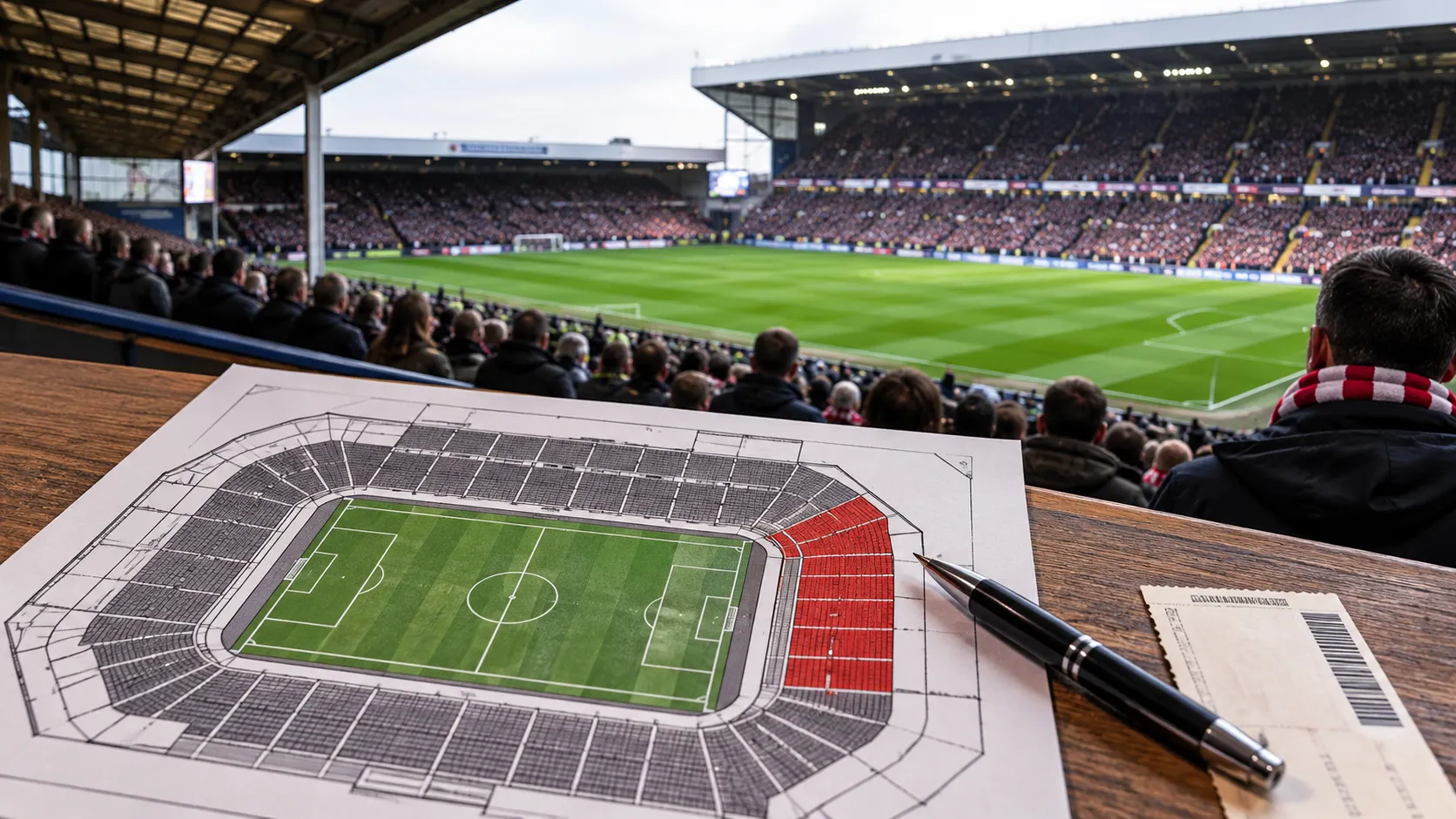
Understanding how away end allocations are decided clears up most of the complaints travelling supporters have, because the answer is a mix of regulation, stadium geometry and club discretion, and the three get confused constantly.
The short version: there is a minimum, it is a percentage rather than a number, and clubs have more room to reduce it than most people realise.
The regulated minimum
English football competition rules require home clubs to make a proportion of capacity available to visiting supporters. The figure most often cited is in the region of five per cent, applied to the ground’s total capacity rather than to any particular stand.
That is a floor, not a target. A club can offer more, and several routinely do for fixtures where demand justifies it, but very few offer substantially more than the minimum for a league match.
Because it is a percentage, the raw number varies enormously between grounds. Five per cent of a sixty-thousand stadium is three thousand places; five per cent of a twenty-five-thousand ground is well under half that, for exactly the same fixture.
Why your allocation changes between grounds
Stadium geometry does most of the work. Away support has to be segregated, which means the allocation has to fit into a contiguous block with its own entrances, concourse and exit routes.
Older grounds frequently cannot offer a clean block of the right size in a sensible location, which is why away sections in them end up in corners, high tiers or oddly shaped pockets. Newer stadiums are designed with the segregation requirement in mind and can offer a tidier block.
The consequence is that two grounds of similar capacity can offer very different away experiences, and the difference is architecture rather than attitude. The Football Supporters’ Association has campaigned on away allocations and pricing for years, and the structural constraint is a recurring theme in that work.
When can a club reduce it?
More often than supporters expect. Safety advisory groups, which include the police and the local authority, can require a reduced allocation for a fixture assessed as higher risk, and the home club has to comply.
Ground works are the second common reason. A stand being redeveloped reduces capacity, and the away allocation reduces with it sometimes disproportionately, because the away block is often in the part of the ground easiest to take out of use.
Cup competitions work differently again, with their own allocation rules that are generally more generous than league ones. This is why a cup tie at a ground where you normally get two thousand places can suddenly offer six or seven.
How clubs decide where to put you
Segregation first, as above. Then revenue, because the away block occupies seats that would otherwise be sold at home prices, and clubs place it where the commercial cost is lowest.
That is the honest explanation for why away support ends up behind a goal, in a corner, or in an upper tier rather than along the side. The best seats in the ground are the most valuable, and no club allocates them to visiting supporters if it has a choice.
Policing considerations are the third factor and sometimes override the second. An away section positioned for easy access from a specific entrance, with a clear route to transport, is easier to manage, and safety advisory groups push for that even where it costs the club money.
What about neutral and hospitality seats?
A route that exists and is worth understanding before you use it. Some clubs sell remaining home-end tickets on general sale, and a visiting supporter can buy one legally, and against the club’s terms of sale in most cases, which means a ticket that can be voided if you are identified.
The practical risk is not enforcement, it is behaviour. Sitting in a home end means sitting still when your team scores, and people who cannot do that get ejected, which is the outcome the policy is designed to produce.
Hospitality is the honest version. It costs considerably more, it is sold to anyone, and it comes with no expectation that you support the home side though the atmosphere is nothing like an away end, which is usually the reason people wanted to go in the first place.
For a ground you simply want to visit, hospitality or a neutral-section ticket is a reasonable way to tick it off. For a fixture that matters, wait for the away allocation.
What this means for getting a ticket
Away tickets at most clubs are distributed by loyalty, and the smaller the allocation the more loyalty you need. The practical implication is that the ground, not the fixture, determines how hard a ticket is to get.
For a small allocation, expect a high threshold and apply the moment the fixture opens. For a larger one, there may be general sale, and there may even be returns available close to the match.
Cup ties are the opportunity. A larger allocation combined with lower demand frequently means tickets available to supporters who would never get one for a league away match, which is the cheapest way into a ground you have not visited.
Why do two clubs in the same city differ?
Because the regulation sets a percentage and everything else is local. Two clubs five miles apart can offer visibly different away experiences, and the reasons are the age of the stand, the segregation routes available, and the view of the local safety advisory group.
Safety advisory groups are the part supporters never see and the part that decides most of the detail. They are made up of the local authority, the police, the fire service and the club, and they issue the ground’s safety certificate which sets not just the total capacity but the capacity of individual sections.
That means an away allocation can be constrained by a decision taken about a stairwell, a concourse width or an exit route years before anyone bought a ticket. Clubs occasionally get blamed for allocations they did not set and cannot change without building work.
It also means allocations change when grounds are modified. A stand refurbishment that improves exit capacity can raise an away allocation permanently, which is one of the few ways the number moves upward.
Is the system fair?
It is defensible and it is not generous. The percentage model means away support scales with the size of the home ground rather than with its own demand, which systematically disadvantages large travelling supports visiting small grounds.
The counterargument is that segregation imposes real costs and real constraints, and that mandating larger allocations would require structural changes to grounds that were not designed for them. That is true, and it does not explain why the minimum has stayed where it is while stadium redevelopment has continued.
Which grounds this bites hardest at is covered in the hardest away days in the Premier League. Pricing is the other half of the argument and has moved further. A cap on away ticket prices has done more for travelling supporters than any change to allocations, as covered in away tickets and the Premier League price cap.
Frequently asked questions
What is the minimum away allocation?
Competition rules set a proportion of total capacity, commonly cited at around five per cent. It is a floor rather than a target, and few clubs exceed it for league fixtures.
Why is my allocation smaller at some grounds?
Because it is a percentage of capacity, and because older grounds often cannot provide a contiguous segregated block of the right size in a good location.
Can a club cut the allocation?
Yes on the instruction of a safety advisory group for a higher-risk fixture, or because of ground works reducing capacity.
Are cup allocations bigger?
Generally yes. Cup competitions have their own, more generous allocation rules, which combined with lower demand makes cup ties the easiest way into an unfamiliar ground.