

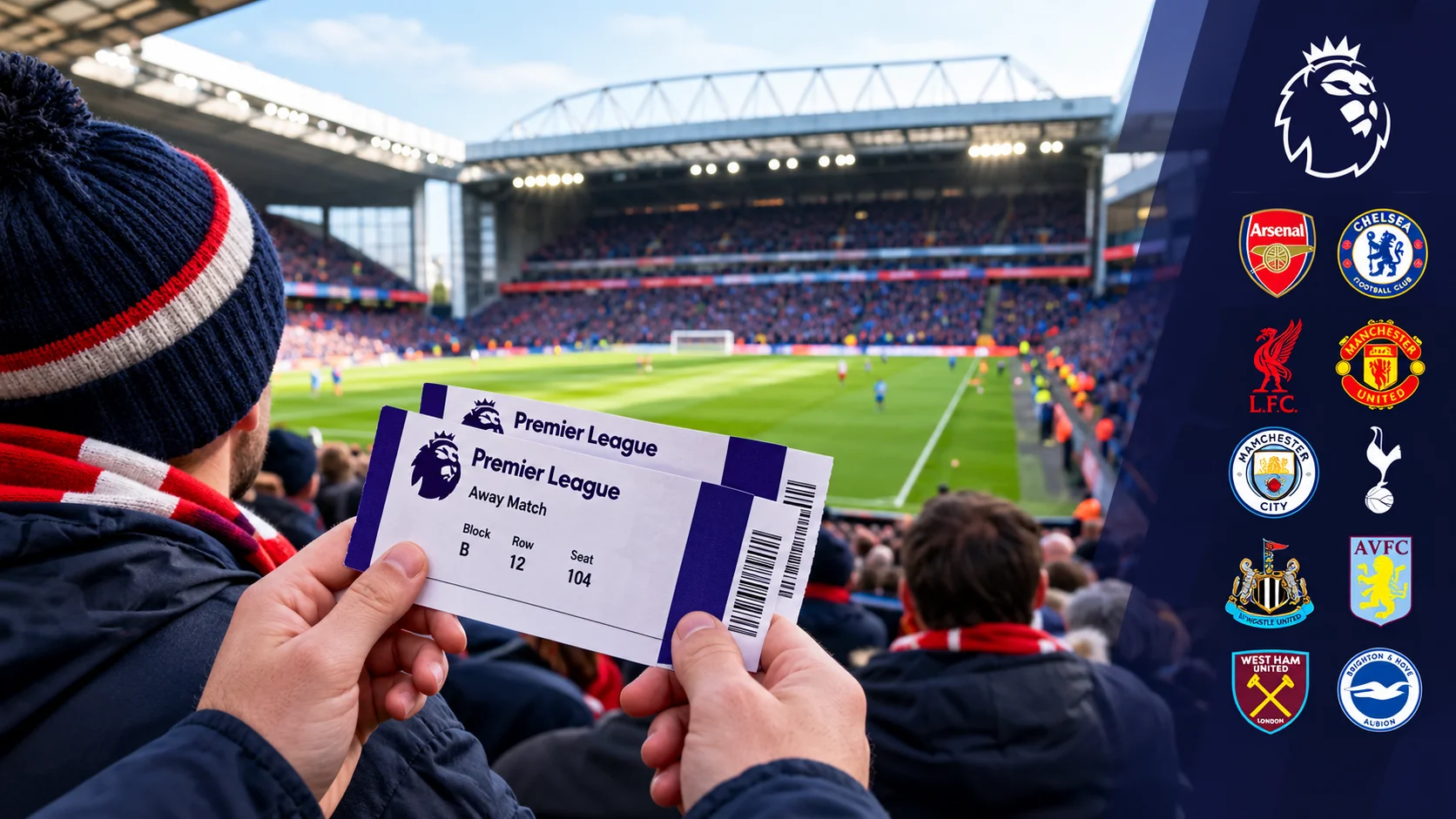
The away end is the smallest section of most Premier League grounds and the hardest to get into. It is also, since 2016, the cheapest, thanks to a rule that caps what clubs can charge visiting supporters. How that came about, and how the tickets are shared out, is worth understanding for anyone who wants to be there.
What is the away ticket price cap?
A limit of thirty pounds on the price of an away ticket in the Premier League, agreed by the clubs in 2016.
Before the cap, away ticket prices had risen sharply, with some clubs charging visiting supporters over sixty pounds for a seat in the worst section of the ground. Supporters’ groups campaigned against it for years, arguing that away fans were the most loyal and the most exploited. The clubs eventually agreed to a cap, initially for three seasons, and it has been renewed since.
It applies only to the Premier League. Cup ties and European matches are priced separately, and the Football League has its own arrangements.
Why did the clubs agree to it?
Partly because of the campaign, and partly because the arithmetic made it affordable.
Away supporters are a small fraction of a Premier League crowd, so capping their ticket price costs each club a modest amount against enormous television income. At the same time, the clubs recognised that away fans produce much of the atmosphere at a ground and that pricing them out damaged the product broadcasters were paying for.
The campaign gave the clubs a reason to act. The economics made it painless.
How are away tickets allocated?
By the home club to the visiting club, which then sells them to its own supporters under its own rules.
Premier League rules require the home club to offer the visiting club a set number of tickets, usually around three thousand, or a percentage of capacity, whichever is greater. The visiting club then decides who gets them, and almost every club uses some form of loyalty system to do so.
That is the part that frustrates newer supporters. The ticket is cheap, but getting one requires a history.
What are loyalty points?
A record of how many matches a supporter has attended, used to rank them when tickets are scarce.
Most clubs award points for each ticket bought, with more points for away matches and for less attractive fixtures. When away tickets go on sale, they are released in stages to supporters with the most points first, then progressively to those with fewer. For a big away fixture, the tickets may sell out before reaching anyone below a high threshold.
The system rewards the supporters who go most often, which is the intention. It also means that someone starting from nothing can take several seasons to build enough points for the fixtures they most want.
How do you build points from scratch?
Slowly, and by going to the matches nobody else wants.
Low-demand away fixtures, midweek cup ties and matches at distant grounds are where points are earned. Supporters starting out typically spend a season or two attending the less glamorous fixtures, accumulating points, until their total is high enough to reach the popular ones. Club memberships often carry a small points bonus as well.
There is no shortcut, which is the system working as designed.
Do points transfer between seasons?
Usually, with a reset or a decay built in.
Most clubs carry a supporter’s points from one season to the next, so a history of attendance keeps its value. Some apply a reduction each summer, so that a supporter who stops going gradually loses priority to those who continue. Others reset entirely after a fixed period. The rules are published by each club and are worth reading, because a system that decays rewards consistent attendance in a way that one carrying points indefinitely does not.
What about the away end itself?
The most exposed section of most grounds and usually the loudest.
Away allocations tend to be placed in a corner or behind a goal, often with the least shelter and the poorest view. Older grounds sometimes have restricted-view seats behind pillars. The trade-off is atmosphere, since three thousand supporters who have all travelled and all sat together produce a noise that home sections rarely match.
Our guide to what separates title winners from top-four sides touches on why away form matters so much, and the away end is where that form is watched most closely.
Does the cap apply to every seat in the away end?
Yes, for league matches, though clubs can charge less.
The thirty pound figure is a ceiling, not a fixed price. Some clubs charge visiting supporters less, particularly for lower-demand fixtures or for concessions. Junior and senior tickets in the away end are usually cheaper again. The cap simply prevents any Premier League club from charging more than thirty pounds for a standard adult away ticket in a league game.
Cup ties are where prices vary, since the cap does not apply and clubs set their own. Early rounds are often cheaper than league matches. Later rounds and semi-finals can be considerably more.
Has the cap changed anything?
Away attendances and the atmosphere in away ends have both held up better than they might have without it, and supporters’ groups regard it as one of their clearest successes.
It has also shifted the argument. With the away price settled, the campaigning focus has moved to home ticket prices, to kick-off times and to the cost of travel, which the cap does nothing about. A thirty pound ticket for a match that requires a train fare several times that amount is still an expensive day.
Can you buy away tickets any other way?
Rarely, and the alternatives are risky.
Resale through the visiting club’s official scheme is sometimes possible when a supporter cannot attend. Buying from unofficial sources is against club rules and carries a real chance of the ticket being cancelled or the buyer being refused entry, particularly for high-profile fixtures. Sitting in the home end wearing away colours is a bad idea at most grounds.
For most supporters, the honest answer is that the away end is earned through points and there is no reliable way round it.
One practical note. Away tickets are usually issued to the supporter who bought them, with the name checked at some grounds, and transferring one to a friend is not always straightforward. Buying in a group means each person needs their own points history, which catches out newer supporters who assumed one member could buy for everyone.
The cap deals with the ticket and nothing else. Travel, food and the cheap football shirts that get bought on the way in are all still priced at whatever the day costs, which is why most regulars budget for the day rather than the match.
Frequently asked questions
How much are away tickets in the Premier League?
Capped at thirty pounds since 2016, for league matches only. Cup and European ties are priced separately.
How many away tickets does each club get?
Premier League rules require home clubs to offer visiting clubs around three thousand tickets or a set percentage of capacity, whichever is greater.
How do loyalty points work for away tickets?
Supporters earn points for each match attended, with more for away and low-demand fixtures. Away tickets are sold in stages, starting with the highest point totals.