

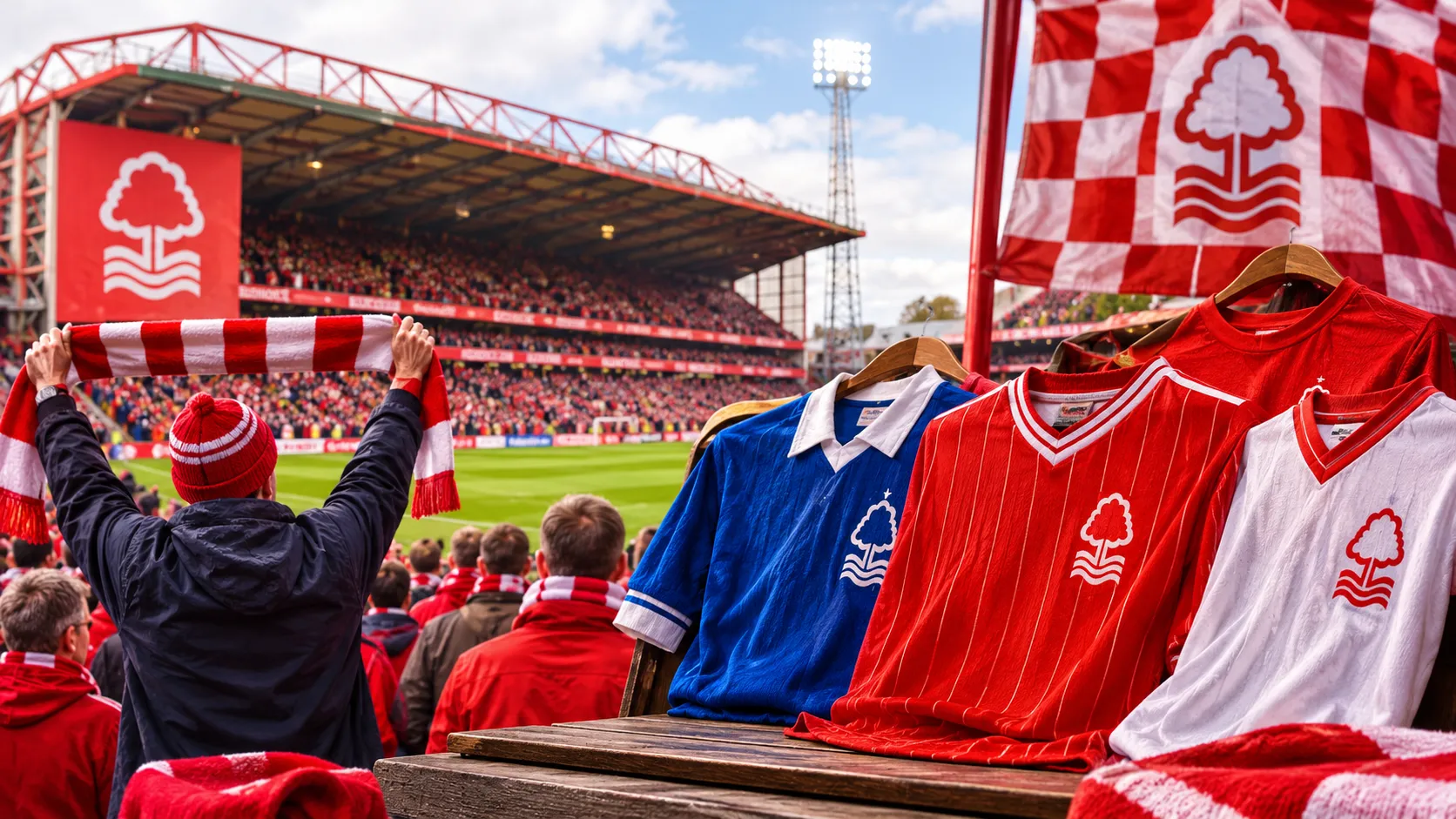
Two things make this trip worth doing, and nottingham forest retro shirts are the second of them. The first is the ground itself: a proper old English stadium on the bank of a river, reached by a walk across a bridge, with a cricket ground on one side and a rival club’s stadium three hundred metres away on the other.
It is one of the best away days in the country for reasons that have nothing to do with facilities, and the shirts are popular for reasons that have everything to do with two seasons at the end of the nineteen-seventies.
What is the walk in like?
From Nottingham station it is about twenty to twenty-five minutes on foot, and the route is the point. You walk down through the city, over Trent Bridge, with the river on both sides and the ground appearing on your left as you cross. On a clear afternoon it is the most pleasant approach to any ground in England.
Trent Bridge cricket ground is immediately beside you, and Notts County’s Meadow Lane is a few hundred metres away on the far bank the two closest professional football grounds in the country. If you are groundhopping, both fixtures in one weekend is an obvious plan and a short walk.
The pubs along the way are busy and mixed, and the area handles a football crowd well because it has been doing it for a very long time. There is no segregated corridor and no long trudge through a retail park, which makes a considerable difference to the day.
The away end and the roof
Visiting supporters are housed in the Bridgford Stand, at one end, and it has the most distinctive feature of any away end in the league: the roof slopes down sharply at one side. That is not a design flourish. The stand was built under a planning restriction that prevented it overshadowing the houses behind, so the roof had to come down.
The practical effect is that the back rows at that side are lower than they would otherwise be, and the acoustics are uneven. It is also, to anyone interested in grounds, a genuinely interesting piece of stadium architecture a visible record of a club negotiating with its neighbours rather than bulldozing them.
The view is good, the stand is close to the pitch by modern standards, and the atmosphere in the away end is generally strong because the home support is loud enough to provoke a response. For how stand design produces this, see how football stadium design shapes the game.
Why do Forest’s old shirts sell so well?
Because of what happened in 1979 and 1980. Nottingham Forest won the European Cup twice in consecutive seasons, having won the league the year before that, with a squad assembled on a modest budget by Brian Clough and Peter Taylor.
It remains the most improbable achievement in English football. A provincial club with no European history, promoted from the second division three years earlier, won the biggest competition in the game twice and no club of comparable size anywhere in Europe has done anything like it since.
A red Forest shirt from that period is attached to all of it, which is why reproductions outsell the current range among a certain kind of buyer and why originals command prices that have nothing to do with the design. The design is a plain red shirt. The association is everything.
Garibaldi red, and dating a Forest shirt
Forest’s red has its own name among supporters. It is called Garibaldi red, after the red shirts worn by Giuseppe Garibaldi’s followers, and the connection dates back to the club’s earliest years which makes it one of the oldest deliberate colour choices in football.
For dating purposes the usual order applies: sponsor first, then the supplier’s logo, then the crest, then the collar. Forest’s crest is unusually helpful because the current tree-and-stars design carries stars marking the European Cups, so a shirt’s star count places it either side of 1980 immediately.
Collars do the rest for the older shirts. The pointed and ribbed collars of the seventies gave way to crew necks later, and a reproduction of a European Cup-era shirt arriving with a plain modern neck has been made to a price rather than to the original.
What else is in the back catalogue
The European Cup shirts dominate demand, but they are not the only ones worth having. The mid-seventies promotion-era designs are plainer and cheaper, and for anyone who prefers a simple red shirt with a pointed collar they are arguably the better garment.
The nineties are where Forest’s designs get busy, and opinion divides accordingly. The shirts from that decade carry the patterning and bold trim of the period, which makes them instantly datable and splits buyers between nostalgia and embarrassment. They are the cheapest Forest shirts available and the slowest to resell.
Away kits across all eras are the quiet value, as at every club. Smaller production runs, lower demand, and more design freedom because the home shirt was locked to Garibaldi red which means the interesting experiments all happened on the alternatives.
Making a day of it
Easily done, and Nottingham rewards it. The city centre is compact, walkable from the station, and has a better pub scene than most places you will travel to for football. The area around the ground is pleasant enough to arrive early for rather than just passing through.
For a two-game weekend, the Forest and Notts County combination is the easiest in England two grounds, one bridge, no transport required between them. Our away day guide to the Gtech covers the other end of the scale, a modern small ground done well.
Getting out afterwards is straightforward: walk back over the bridge into town and you are at the station in twenty-five minutes without queueing for anything. That alone puts it ahead of half the league.
Where the home support sits
Worth knowing because it shapes the noise. The Trent End behind one goal is where Forest’s vocal support concentrates, and it is close enough to the pitch to be heard properly rather than dissipating into a bowl. The Brian Clough Stand runs down one side and carries the name for obvious reasons.
The ground’s capacity is a little over thirty thousand, which by Premier League standards is small and that is the whole reason the atmosphere works. A full thirty-thousand ground with the stands tight to the pitch produces more noise than a half-full sixty-thousand one, every time.
Redevelopment has been discussed for years, constrained by the river on one side and the houses on the other. Whatever eventually happens, the current configuration is one of the better away experiences in the division and worth doing while it lasts.
Practical notes
Cash is less useful than it was but the pubs on the route in are quicker with it. Dress for a river it is noticeably colder on the bridge and in the stand than in the city centre, and the wind comes down the Trent.
Allow more time than the map suggests if you are coming by train on a Saturday, because Nottingham station’s connections from the north and west are prone to weekend engineering work. And check the kick-off time rather than assuming, since this is a fixture broadcasters like. Ticket pricing for all of this is covered in how football clubs set season ticket prices.
Frequently asked questions
How far is the City Ground from Nottingham station?
About twenty to twenty-five minutes on foot, over Trent Bridge. It is a pleasant, flat walk through the city and one of the better approaches in the league.
Why does the away stand have a sloping roof?
A planning restriction prevented the Bridgford Stand overshadowing the houses behind it, so the roof was built lower at that side. It is a visible record of the club’s agreement with its neighbours.
Why is Forest’s red called Garibaldi red?
After the red shirts worn by Giuseppe Garibaldi’s followers. The connection goes back to the club’s earliest years and makes it one of the oldest deliberate colour choices in football.
Can I do Forest and Notts County in one weekend?
Yes, and it is the easiest double in England. The two grounds are a few hundred metres apart on opposite banks of the Trent.