

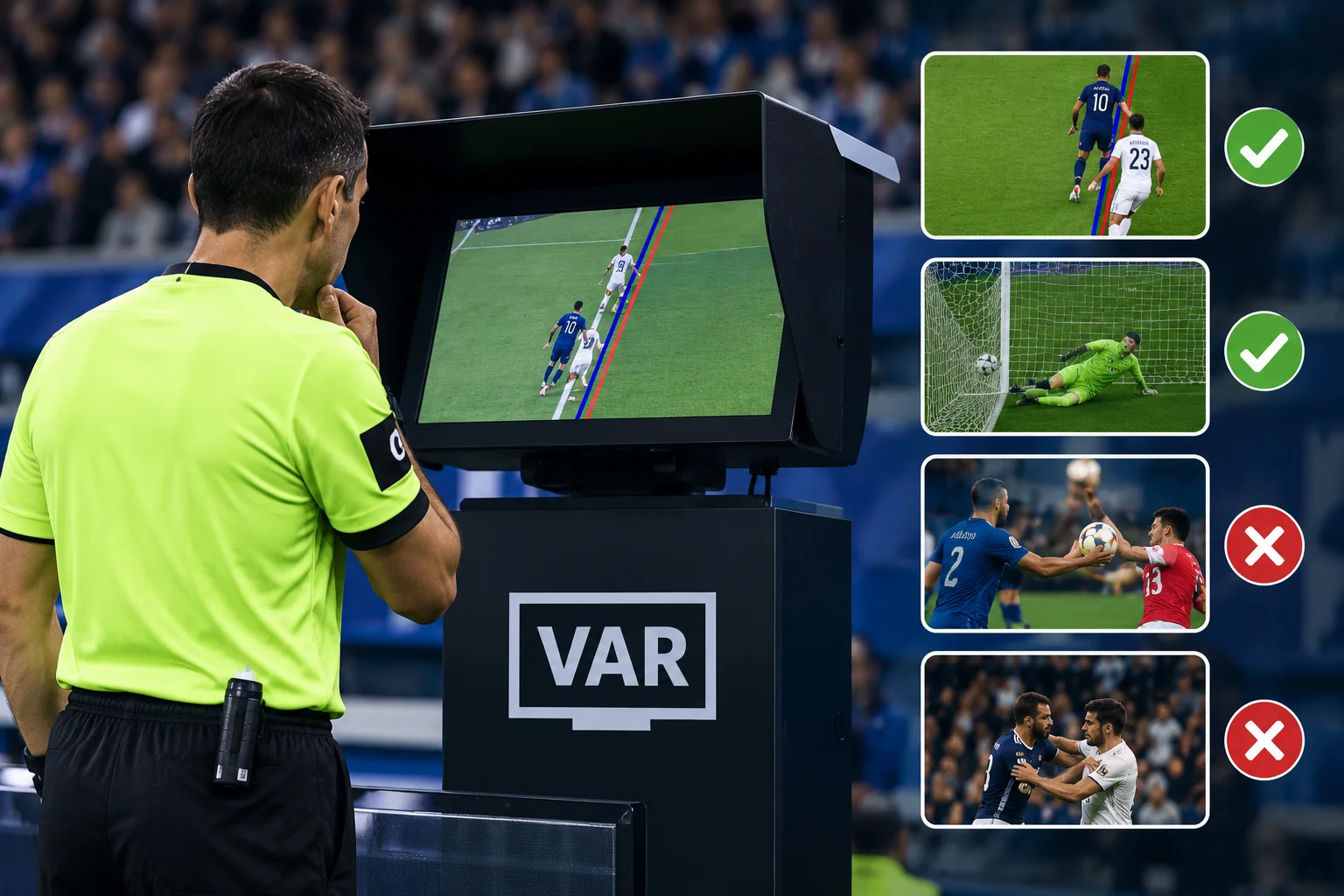
Video review arrived promising to remove the clear mistakes that had decided matches for a century. It has removed some of them. It has also created new arguments, changed how goals are celebrated, and shifted the controversy rather than ending it. Few changes to football have been so widely wanted beforehand and so widely complained about afterwards.
Here is what VAR actually does, what it has changed, and why the arguments have not stopped.
What is VAR meant to do?
Correct clear and obvious errors in four specific situations.
Video review is limited by design to four types of decision: goals, penalties, straight red cards, and cases of mistaken identity. It is not meant to re-referee the match or to review every decision. It intervenes only when the on-field official has made what the review considers a clear and obvious error in one of those four areas, and the referee usually makes the final call after reviewing the replay.
That limited scope is important, and much of the frustration with VAR comes from the gap between what it was meant to do and what supporters expected it to do.
Why has it caused so much controversy?
Because “clear and obvious” is a judgement, and judgements can be argued with.
The promise of video review was objectivity, but most of the decisions it handles are not objective. Whether a challenge is a foul, whether contact was enough for a penalty, whether an incident was a clear error: these are matters of opinion, and reviewing them on video does not make them less so. VAR replaced an argument about what the referee saw with an argument about what the review decided, which is not obviously progress.
The situations where it works best are the factual ones. Whether the ball crossed the line, or whether a player was offside, can be checked objectively, and in those cases VAR has genuinely reduced error.
Does it affect how teams play?
A little, and defenders have adapted most.
Knowing that marginal handballs and penalty-box contact will be reviewed has made some defenders more cautious with their hands and their challenges in the area, since an offence that might once have gone unseen is now likely to be caught. Attackers, conversely, have learned that going down under contact in the box may be reviewed in their favour. Neither change is dramatic, but players adjust to how decisions are actually made, and VAR has shifted that calculation at the margins.
What has it changed about watching football?
The celebration, most noticeably, and the rhythm of a match.
A goal is no longer certain the moment it is scored. Supporters now celebrate and then wait, watching for the review, and a goal ruled out after a long check drains the moment entirely. The delays interrupt the flow of a match, and the sight of a referee staring at a pitchside screen has become one of the defining images of modern football, rarely a popular one.
The offside decisions have drawn particular criticism, since a player can now be ruled offside by a margin too small to see with the naked eye, which many feel defeats the spirit of a rule meant to penalise a clear advantage.
Has it made decisions more accurate?
In the factual areas, yes. In the subjective ones, it is debatable.
Offside and goal-line decisions are measurably more accurate than they were, and clear errors that would once have stood are now corrected. That is a real gain. But in the subjective areas, fouls and penalties, VAR has not produced the consistency that was hoped for, because the underlying decisions were always matters of interpretation, and different officials interpret them differently whether they are watching live or on a screen.
So the honest answer is that VAR has improved accuracy where accuracy was possible and left controversy where it was always inevitable.
Has it changed the referee’s job?
Significantly, and not only in the obvious way.
A referee now works knowing that major decisions will be reviewed, which changes how they officiate: some have become more willing to let play continue and allow the review to catch anything serious, rather than stopping the game on a marginal call. The relationship between the on-field referee and the video official is still being worked out, and the balance between the two, who defers to whom and when, is one of the least settled parts of the system. The referee remains in charge in principle; in practice the screen exerts a strong pull.
Could it be done better?
Most of the proposed fixes are about process rather than principle.
Setting a higher bar for intervention would mean VAR stepped in only for the clearest errors, which was the original intention and would reduce the number of marginal re-decisions. Speeding up the review would reduce the interruptions. Keeping the on-field referee genuinely in charge, rather than deferring to the screen, would preserve the human judgement the game is built on. And better communication with the crowd, so supporters in the ground know what is being checked and why, would reduce the sense of mystery that breeds frustration.
None of these removes the fundamental problem, that subjective decisions stay subjective, but together they would address most of what supporters actually complain about.
Why do the arguments continue?
Because the problem VAR was meant to solve was partly unsolvable.
Football is a flowing, physical game full of marginal incidents, and many of its most important decisions will always be judgement calls. No technology can remove subjectivity from a subjective decision. VAR can catch the clear mistakes, and it does, but the belief that it would end controversy was always mistaken, because most football controversy is not about clear mistakes. It is about where the line should be drawn, and that is an argument no replay can settle.
The debate now is less about whether to have VAR and more about how to use it: how high to set the bar for intervention, how to speed up the process, and how to keep the human referee in charge rather than deferring to a screen. Our piece on how Premier League fixtures are scheduled covers another part of the modern game shaped by television, which is where much of the pressure for VAR came from.
Frequently asked questions
What can VAR review in football?
Four situations: goals, penalty decisions, straight red cards, and cases of mistaken identity. It is not meant to review every decision or re-referee the match.
Has VAR made football more accurate?
In factual decisions like offside and goal-line calls, yes. In subjective decisions like fouls and penalties, it has not produced the consistency hoped for, because those were always matters of interpretation.
Why do people dislike VAR?
Because it interrupts the flow of matches, delays goal celebrations, rules players offside by invisible margins, and replaced arguments about the referee’s view with arguments about the review’s decision.