

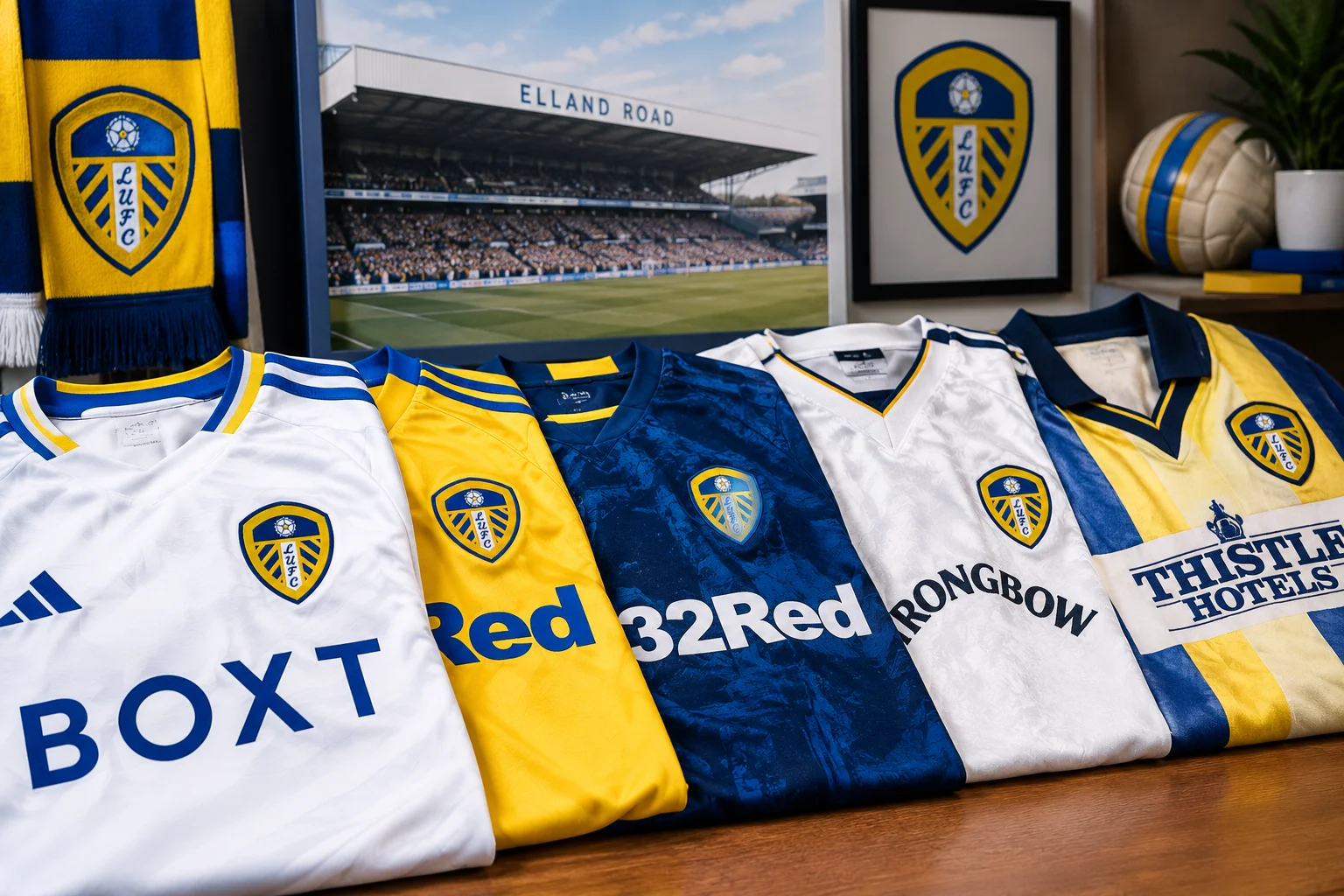
Leeds have one of the most distinctive kit identities in English football, and also one of the simplest. All white at home, with a badge, and that is largely it. The club has worn that combination since the sixties, and while suppliers and sponsors have come and gone, the basic look has barely moved.
That simplicity makes the full range easier to navigate than most clubs’, but it also means the differences between products are harder to see at a glance. A plain white shirt at thirty pounds and a plain white shirt at a hundred look very similar in a photograph. This guide sets out what each part of the range is, what you actually get for the money, and which version suits which buyer.
The home shirt, and why it is always white
Leeds adopted all white deliberately, in imitation of Real Madrid, under Don Revie in the nineteen-sixties, and it has been the club’s identity ever since. Changes happen at the margins: the width of any trim, whether the shorts are white or blue, the collar shape, the badge treatment.
For a buyer, that is good news. A Leeds home shirt from almost any recent season still looks current, because there is no bold pattern or colour-blocking to date it. The practical consequence is that you can buy last season’s design at a discount without it looking obviously out of date, which is harder to get away with at clubs whose home shirt changes substantially each year.
The thing to look at instead is the badge, which has changed more than the shirt. The current crest and its predecessors are the fastest way to date a white Leeds shirt, so if you are buying for a specific season, check the badge against a photograph before ordering.
Replica, stadium and player versions
Most clubs now sell two or three tiers of the same shirt, and the names vary by supplier. The entry-level replica is cut generously, uses a single fabric throughout and has a stitched or heat-pressed badge. The mid-tier adds better fabric and sometimes ventilation panels. The top tier, usually called a player or authentic version, is cut close, uses a lighter engineered fabric and has bonded rather than stitched seams.
The price gap between the bottom and top of that range is substantial, often double. Whether it is worth it depends entirely on what you want the shirt for. If you are going to play in it, the player version is a better garment and the extra cost is defensible. If you are going to wear it to a match or around the house, the standard replica is more comfortable and will survive more washes.
A word of warning on sizing. Player versions are cut for athletes and run small through the chest and short in the body. If you normally take a large in a replica, you will probably want an extra large in the authentic version of the same shirt.
Away and third shirts
This is where Leeds get adventurous, because they have to. With a fixed white home shirt, the alternatives are the only place a supplier can do anything interesting, and over the years that has produced yellow, blue, navy, black and various combinations of the three.
The yellow and blue away shirts are the ones with the strongest following, because they connect to the club’s colours as a whole rather than just the home kit. Black and dark grey third shirts tend to be less popular and therefore cheaper, which makes them good value if you want something from a particular season without paying home-shirt money.
Alternative kits are also discounted harder and earlier than home shirts, so if you are patient, the away and third are where the genuine bargains in the range sit. leeds united shirts in the alternative colours routinely drop by half once the next season’s designs are announced.
What about training wear and retro?
Training kit is the quiet value in most club ranges, and Leeds are no exception. Training tops and quarter-zips are made from the same technical fabrics as match kit, they are cut for movement, and they are usually cheaper than a replica shirt because they carry no league badges or sponsor arrangement. If you want something to actually exercise in, start here rather than with a match shirt.
The retro range is a different proposition. Leeds have an unusually strong back catalogue for reproduction — the sixties and seventies all-white with the smiley badge, the eighties and early nineties designs with their period trim — and there is a healthy market in them. Retro cuts are boxier and shorter in the sleeve than modern shirts, so measure rather than guessing, and check whether the version you are buying is an officially licensed reproduction or a generic tribute, because the badge detail is usually where the difference shows.
Kids’ kits and the rest of the range
The children’s range follows the adult one but with two differences worth knowing. Kids’ shirts are generally only produced at the entry replica level, so there is no player-version decision to make, and the sizing is by age rather than by measurement, which is where most of the problems come from.
Age labels vary enormously between suppliers and between seasons from the same supplier. A shirt labelled for an eleven-year-old may fit like one labelled nine from a different brand. Buy on the chest measurement rather than the age, and if you are buying as a gift and cannot measure, size up — a slightly loose shirt gets worn for two seasons, a tight one gets worn for none.
The rest of the range tends to be where the margin is. Scarves, hats, mugs and keyrings are licensed products rather than kit, and the quality varies by licensee rather than by club. A club-shop scarf is usually decent; a keyring usually is not.
Which Leeds shirt should you buy?
Three straightforward answers, depending on the buyer. For a supporter who wants the current shirt to wear to games, the standard replica home is the right choice, and buying it a month into the season rather than at launch saves money without any downside.
For someone who plays or trains, buy a training top or a player-version shirt, not a replica. For a gift, the away or third shirt from the previous season is the best value in the range, because it is heavily discounted and still looks current.
Across the league the same logic applies with different numbers, and our comparison of Premier League kit ranges sets out where each club’s range sits on price.
Frequently asked questions
Why are Leeds United’s home shirts always white?
The club adopted all white in the nineteen-sixties under Don Revie, modelled on Real Madrid, and has kept it as a permanent identity. Details change but the colour does not.
Is the player version worth the extra money?
Only if you are going to play in it. It is lighter, closer cut and better engineered for movement, but it is less comfortable for casual wear and it runs at least a size small.
When do Leeds shirts get discounted?
Alternative kits usually drop in price around the turn of the year and fall sharply once the following season’s designs are announced. Home shirts hold their price longer.
How do I check a retro Leeds shirt is accurate?
Look at the badge, the collar construction and the sponsor, and check all three against a photograph of the season the shirt claims to be. Those are the details cheap reproductions simplify first. If you are planning a trip to Elland Road, how the Championship play-offs work is useful background on how clubs get there.