

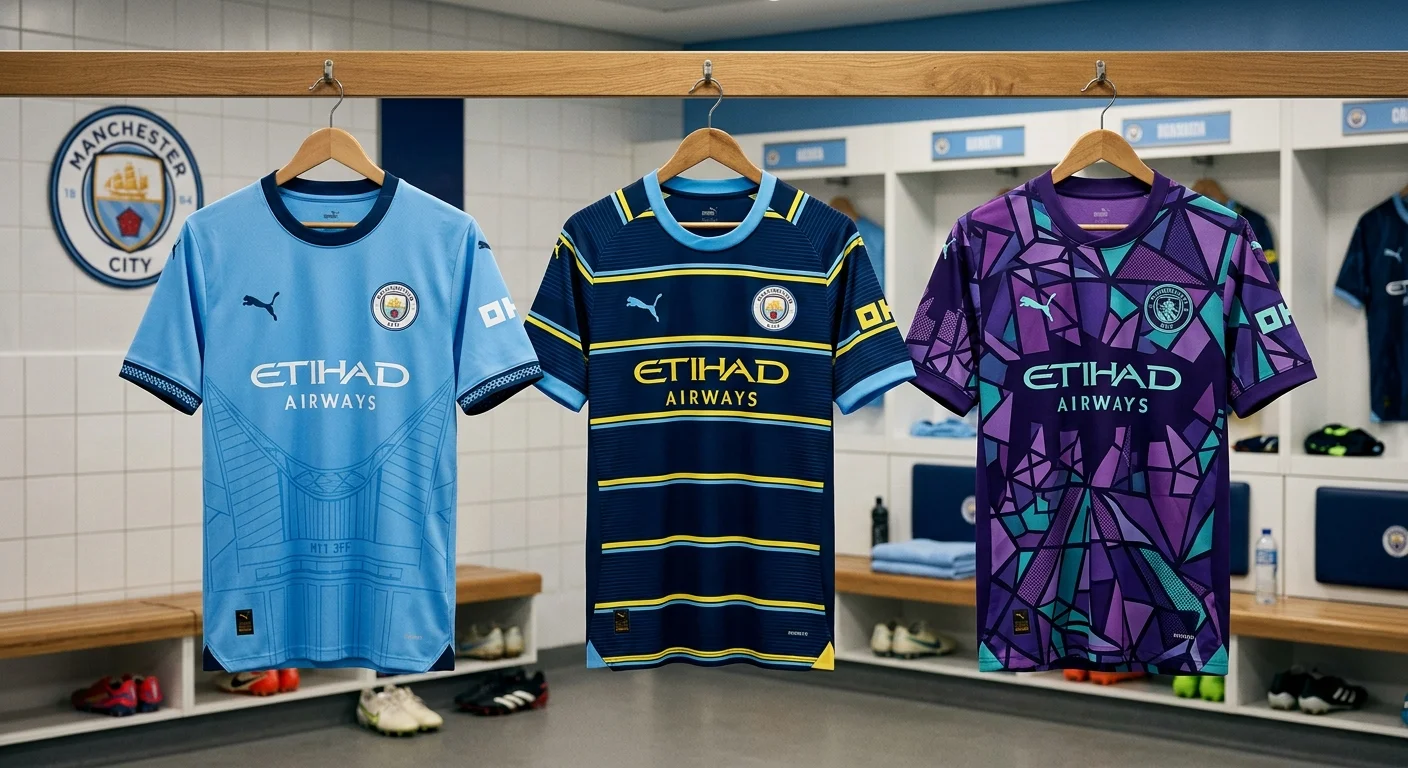
Buying a City shirt usually means choosing between three garments released on the same day, priced identically, and treated by most coverage as interchangeable. They are not. They differ in how many were made, how fast they lose value, and how long they stay recognisable, and those differences are larger than anything visible in a product photograph.
Understanding the structure of a club’s range is more useful than any individual opinion about this year’s designs.
How many of each are actually made?
Nobody publishes exact figures, but the ratios are consistent across the league and they explain most of what follows.
The home shirt is produced in by far the largest quantity. It is the default purchase, it sells to casual buyers as well as committed ones, and manufacturers stock it deep across every size because they know it will move.
The away shirt is produced in meaningfully smaller numbers. The third kit smaller again, often substantially so. That gap is why availability diverges through a season: home shirts remain purchasable in every size well into the following year, while third kits in popular sizes frequently disappear by spring.
Why does the sky blue complicate the home shirt?
Because it sits in a narrow band where small production variance is immediately visible.
Sky blue is the least forgiving colour in English football. A slight shift one way reads as washed out, a slight shift the other as faintly turquoise. Clubs in red or white have margin for error. City do not, and a poorly controlled production run announces itself.
That makes the home shirt the most useful quality test in the range. When comparing manchester city kits across sellers, look at whether the shade holds consistent from listing to listing and whether sleeves match the body within a single shirt. Inconsistency there is a manufacturing fault, and it rarely occurs in isolation.
Which kit holds its value longest?
The away shirt, in most seasons, and the reason is the production gap above combined with design freedom.
Home shirts are constrained. The colour is fixed, the template is usually shared with other clubs on the same manufacturer’s books, and the changes between years are confined to collar, trim and small pattern detail. They date slowly in appearance and quickly in status.
Away shirts change dramatically year to year, use colours the club never otherwise wears, and are made in smaller numbers. A good one stops being “last year’s away kit” and becomes a design people recognise on its own terms. That is where the longevity sits.
Third kits are the highest variance. Made in the smallest numbers, so genuine scarcity if the design lands, and an orphan if it does not.
How does pricing move across a season?
Predictably, and differently for each of the three.
All three launch in summer at the same price and hold it through the opening months. Reductions begin after the new year and become serious in spring as sellers clear stock before the next release.
Where they diverge is depth. The home shirt reduces but remains available in every size, so waiting costs you nothing. The away shirt reduces with thinner stock. The third kit frequently sells through in common sizes before any meaningful reduction arrives, which means waiting for a discount on a third kit is a genuine gamble rather than a free option.
How long does each kit stay available?
Worth planning around, because the three diverge sharply after the first few months.
Home shirts remain purchasable in every size well into the following year, and often beyond. Manufacturers stock them deep because demand is predictable, so there is no urgency and no penalty for waiting.
Away shirts thin out through the spring, with the most common sizes going first. Third kits can disappear entirely in popular sizes before the season ends. If a third kit is what you want, treat availability rather than price as the constraint and buy accordingly.
Do long sleeve versions change the picture?
They are the most overlooked part of any club’s range.
Long sleeve versions are produced for most clubs in far smaller quantities than short sleeve, and they are substantially more comfortable for winter games worn over a base layer. Because they sell in low numbers they are also scarcer years later, which gives them a collectability the short sleeve equivalent does not always have.
For anyone attending games between November and February, a long sleeve shirt is worth having and rarely costs more than the standard version.
Replica or player version?
Two different builds, and the difference is larger than the price gap suggests.
The replica is made for wearing: slightly heavier knit, conventional stitching, cut with room, and built to survive repeated domestic washing. The player version is made for playing: lighter, tighter, more aggressive ventilation, frequently bonded seams to reduce friction.
For anyone not actually playing in it, the replica is the correct purchase. It is more comfortable, more durable, more forgiving on sizing and usually cheaper. Crucially it also has the room to be worn over a base layer, which a player version does not, and that matters for anyone going to games in winter.
What should you check before ordering?
Three checks, and they apply to every shirt in the range.
Crest attachment first: embroidered or properly bonded crests last years, heat pressed badges lift at the corners within months. Stitching second, at the hem and sleeve cuffs, which carry the most stress. Fabric texture third, visible in any decent close up, with well made shirts showing structure and variation rather than a uniform flat surface.
Then sizing. Measure a shirt you already own across the chest, armpit seam to armpit seam, and match that half chest figure to the chart rather than relying on the size letter.
Which one should you buy?
If you want the shirt everyone recognises and you will replace it in a couple of years, the home kit. If you want something that will still look like a deliberate choice in five years, the away. If you already own both and want the one nobody else has, the third kit, and buy it early because waiting will not work.
And whichever you choose, last season’s version is the best value item on the market at almost any point in the year.
Chelsea structure their range differently, and our comparison of the Chelsea home, away and third kits shows how. For the ground level view of this kit in use, the Etihad away day covers it.
Frequently asked questions
Which Manchester City kit holds its value best?
Usually the away shirt. It is produced in smaller numbers than the home kit and changes more dramatically between seasons, so the good ones stay recognisable for years rather than months.
Should I wait for a discount on a third kit?
Risky. Third kits are made in the smallest quantities and frequently sell through in common sizes before meaningful reductions arrive. Home shirts can safely be waited out.
Is the player version worth buying?
Only if you are playing in it. The replica is more durable, more comfortable, cheaper and has the room to layer underneath, which the tighter player cut does not.