

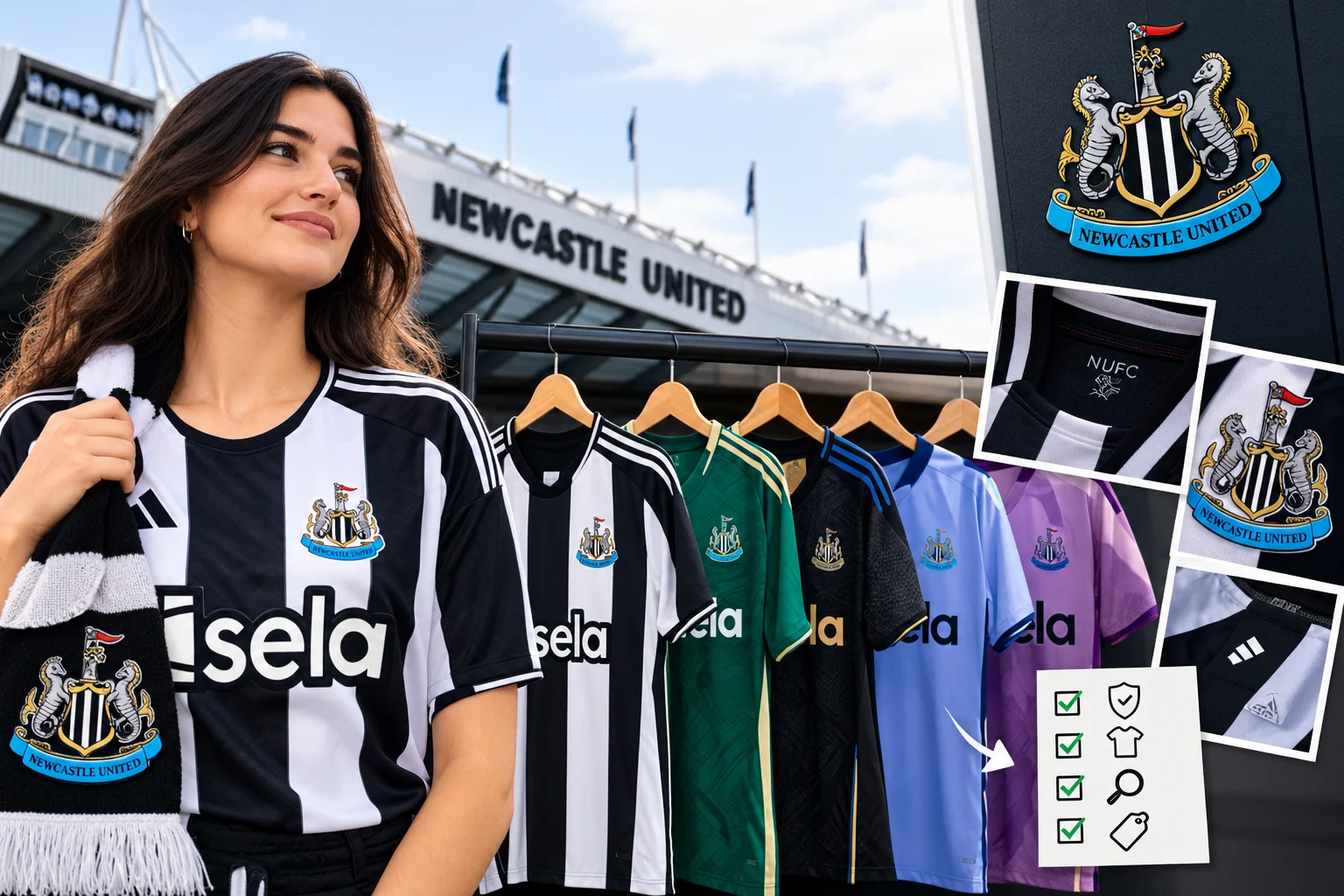
Newcastle’s black and white stripes are among the most recognisable kits in English football, and they are also among the hardest to produce well. That makes the club’s range unusual: the home shirt carries more production risk than most, while the away and third kits sidestep it entirely. Knowing which is which changes what you buy and what you check.
What constrains the home shirt?
The stripes, which have to line up.
A striped shirt has to solve a problem a plain one never faces: the pattern must align at every seam, at the shoulder and down the sides. Doing that requires careful cutting and more fabric waste, which is one of the first economies in a rushed production run. On a well-made shirt the stripes continue cleanly across the seams; on a poorly made one they step out of line, and once you have seen it you cannot unsee it.
That makes seam alignment the first check on any home shirt. Anyone comparing newcastle united kits should follow a single stripe across the shoulder seam before anything else, because it correlates strongly with how carefully everything else was made.
What else does the home shirt demand?
Stable dye, because the white half shows everything.
The white stripes pick up a grey cast through washing if the fabric is poor, and they sit directly against the black in every wash, which is the worst arrangement if the dye is not properly fixed. Check the boundary between black and white in a close-up: it should be sharp, with no bleed. Soft edges mean unstable dye that will keep transferring, and on a half-white shirt that is a serious problem rather than a cosmetic one.
Stripe width consistency is the third check. On a well-made shirt the stripes are even; uneven widths mean the fabric was stretched during cutting.
Where does the design freedom go?
Into the away and third kits, which avoid the stripe problem entirely.
A plain away shirt has far fewer ways to go wrong in production than a striped home shirt, which makes a budget away kit a lower-risk purchase. Newcastle’s away shirts have used various colours over the years, and because they change more dramatically between seasons and are made in smaller numbers, the good ones stay distinctive longer. Third kits push further again and sell in the smallest numbers.
If you want the shirt that reads as Newcastle from across a room, buy the stripes and check the seams carefully. If you want value with fewer ways for it to go wrong, the away kits are the safer bet.
Shirt only or full kit?
The shirt, for most people, and more so with stripes.
A full kit adds shorts and socks, and on a striped kit the pieces have to match: the black and white of the shirt, the black of the shorts, the detailing of the socks. Mismatches between the pieces are common at the cheaper end, since shirt, shorts and socks are often different fabrics that take dye differently. Buying the shirt alone avoids that, and it is the part most people actually want. If you do buy the full kit, check the three pieces match in the photographs.
Which holds its value longest?
The away shirt, usually, with one exception specific to this club.
Away shirts from seasons with an unusual colour or a short-lived sponsor hold their appeal, as at any club. The exception is stripe proportion: because the balance of black to white has shifted across Newcastle’s history, home shirts from seasons with unusually wide or narrow stripes stay recognisable in a way standard proportions do not, and those hold value better than most home shirts.
How do you date a Newcastle shirt?
Stripe proportion first, which is specific to this club.
The balance of black to white has shifted across the decades, and shirts from seasons with unusually wide or narrow stripes place themselves immediately. After that, the sponsor pins a shirt to a block of years, the crest version points to an era, and the sleeve treatment helps, since some eras carried the stripes onto the sleeve while others used plain black sleeves against a striped body. Those four together narrow most shirts to a small range.
The shorts and socks can help too. Black shorts have been standard for most of the club’s history, with white appearing in certain periods, so a full kit carries more dating information than the shirt alone.
How does pricing move?
The usual annual pattern, with the usual stock-depth difference.
All three launch in summer at full price and hold it through autumn. Reductions start after the new year and become serious in spring. The home shirt remains available in every size well into the following year, so waiting costs nothing. The away shirt reduces with thinner stock, and the third kit frequently sells through in common sizes before meaningful reductions arrive. Last season’s home shirt is the best value in the range at almost any point.
Replica or player version?
The replica, for almost everyone, and it matters more on a striped shirt.
The replica is cut with room, which suits a striped kit, because a shirt that fits too closely distorts the pattern across the chest. The player version is tighter and lighter, with its own size chart, and ordering one in your usual replica size gives you something too tight. Measure a shirt you already own across the chest and match the number to the chart. On a striped shirt, if you are between sizes, the larger tends to look better.
For how a club with a single-colour kit handles the same range, our comparison of Chelsea’s home, away and third kits covers a shirt where panel matching matters more than pattern matching.
A short summary for the range, then. Buy the stripes and check the seams if you want the classic; buy the away kit if you want value with less to go wrong; and whatever you choose, last season’s version is the best price for near-identical quality.
Frequently asked questions
How do I spot a badly made striped football shirt?
Follow one stripe across a seam, particularly where the sleeve meets the shoulder. If it steps out of line, the pattern was not matched during cutting, which is one of the first economies in a cheap production run.
Are Newcastle away kits easier to buy cheaply?
Generally yes. A plain away shirt avoids the stripe-matching problem entirely, so it has fewer ways to go wrong in production than a striped home shirt.
Why do the white stripes go grey?
Either poor-quality white polyester picking up a grey cast through washing, or dye transfer from the black stripes. Washing separately for the first few cycles reduces the second cause considerably.