

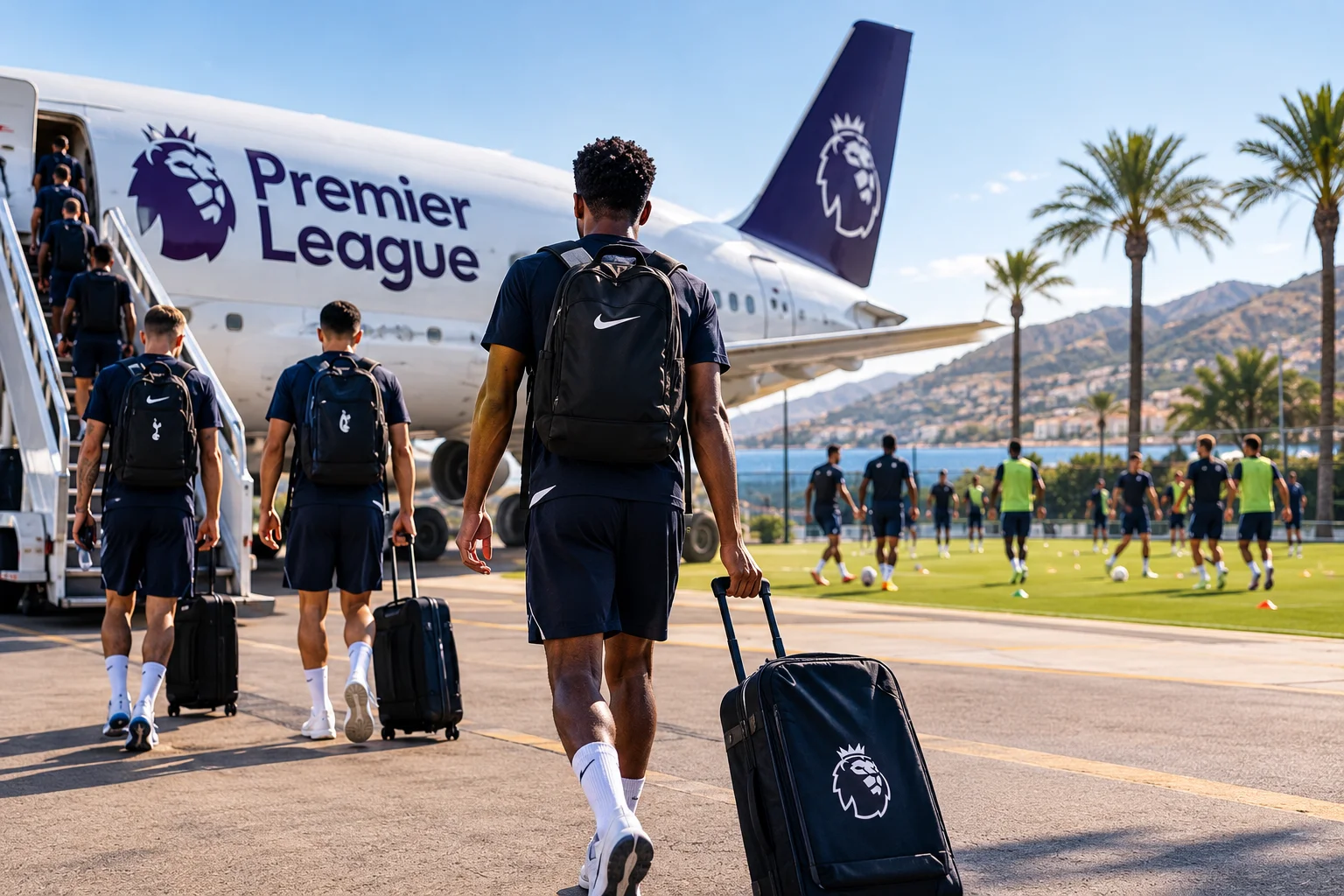
Every July, most of the Premier League gets on a plane. Squads that have had three or four weeks off fly to the United States, to Asia, to Australia or to the Gulf, play three or four friendlies in unfamiliar heat, and come home a fortnight before the season starts.
From a purely physical point of view this is close to the worst way to prepare for a nine-month campaign. Long flights, time-zone changes and hot weather are three of the things a conditioning coach would most like to avoid in the weeks when a squad is building its base fitness. Clubs do it anyway, and the reasons are worth setting out properly, because they are not all financial.
The money, which is the main reason
A pre-season tour generates revenue in several directions at once. Tournament organisers and local promoters pay appearance fees to bring well-known clubs to a market. Matches sell tickets in large stadiums at high prices. Broadcast rights for the friendlies are sold. And sponsors, many of whom are based in the regions being visited, get the access they are paying for.
Add it up and a well-organised tour can be worth several million pounds to a large club before a competitive ball is kicked. For clubs operating under financial rules that limit losses, that is not a trivial amount — it is revenue that directly expands what the club can spend.
Commercial growth, which is the longer game
The deeper reason is market development. The Premier League’s commercial model depends on a global audience, and the clubs with the largest international followings earn the most from sponsorship and merchandise. Those followings are built by being visible in a market, and a pre-season tour is the only time a first-team squad is available to travel.
That is why the destinations follow commercial logic rather than football logic. Clubs go where their sponsors are, where their shirt sales are growing, and where a broadcaster is building an audience. A fortnight of visibility in a major market is treated as an investment rather than as a cost, and the clubs doing it most aggressively are the ones with the largest commercial departments.
What do the players actually get out of it?
Less than the schedule implies, but not nothing. Pre-season has three jobs: rebuild physical conditioning, integrate new signings, and rehearse whatever the manager wants to do differently this year. A tour serves the second and third of those reasonably well.
Playing four matches in unfamiliar conditions against unfamiliar opponents forces a squad to work things out together, and the enforced proximity of a travelling group does more for integration than a fortnight at a training ground. Managers often say the team-building is the genuine football benefit, and they are probably right.
Conditioning is where the tour costs more than it gives. High heat and humidity limit how hard a squad can train, long flights disrupt sleep, and the travel itself takes days out of a short window. Clubs now compensate by doing the hard physical work before departure and treating the tour as a tactical and commercial exercise.
What the tour means for supporters
For fans in the host market, a tour is often the only realistic chance to see the team, and clubs have got better at recognising that. Open training sessions, stadium events and supporters’ club gatherings are now built into the itinerary rather than added as an afterthought.
For supporters at home it is a different experience. Pre-season has effectively moved out of reach: friendlies that were once played at the training ground or at a nearby lower-league club in front of a few thousand people now happen eight time zones away at inconvenient hours, available on a club streaming service. Several clubs have responded by scheduling one home friendly in the final week before the season, which is a reasonable compromise and well worth going to — the tickets are cheap and the squad is nearly settled.
The one thing not to do is read too much into the results, for the reasons above.
The travel load problem
Crossing several time zones takes roughly a day per zone to adjust to, and a tour that goes east, plays, then comes back west inside two weeks never allows full adjustment in either direction. Players arrive back for the opening fixture with a sleep debt that will take another week to clear.
Clubs manage this with chartered flights timed to arrive in the morning, controlled light exposure, and carefully planned sleep schedules, all of which help and none of which eliminates the problem. The players who suffer most are the ones who also played an international tournament in the summer, which is why squads increasingly travel without their most heavily used internationals.
Clubs have also started splitting the squad, which is the most practical adaptation of the last few years. A senior group travels for the commercial fixtures while a second group of academy players and returning internationals stays behind to do the physical work at the training ground under the fitness staff. It satisfies the sponsors and protects the players who most need protecting, and it is now common enough to be the default at the larger clubs.
Is there a better way to do it?
Clubs and leagues have experimented. Grouping several Premier League sides into a single tournament in one country reduces the number of separate trips and the amount of travel for everyone involved, and it produces better matches than a friendly against a local side. Shorter tours, with two matches instead of four, are now common.
The other option, a European training camp with warm-weather conditions and no long-haul flight, is what most clubs would choose on football grounds alone. A few do. The reason more do not is that the commercial return from Europe is close to zero, and the commercial return is the point.
For supporters, the practical upshot is that pre-season tells you very little. A side that looks sharp in Philadelphia in July may be nothing of the sort in August, and a heavy defeat in a tournament friendly is usually a squad three days off a flight. Judge it in September. If you are planning your own trips for the season ahead, our guide to Leeds United’s shirt range is a reasonable place to start on the kit side.
Frequently asked questions
How much does a pre-season tour earn a club?
A large club can earn several million pounds from appearance fees, ticketing, broadcast rights and sponsor activation on a single tour. Smaller clubs earn considerably less, which is why they tour less far.
Does pre-season form predict anything?
Very little. Squads are at different stages of conditioning, line-ups change at half time, and the results are affected more by travel and heat than by quality.
Why do clubs not just train in Europe?
Many would prefer to on football grounds. Long-haul tours happen because the commercial return from major overseas markets is far higher, and that revenue counts towards what a club can afford to spend. The same financial logic drives the rules covered in profit and sustainability.