

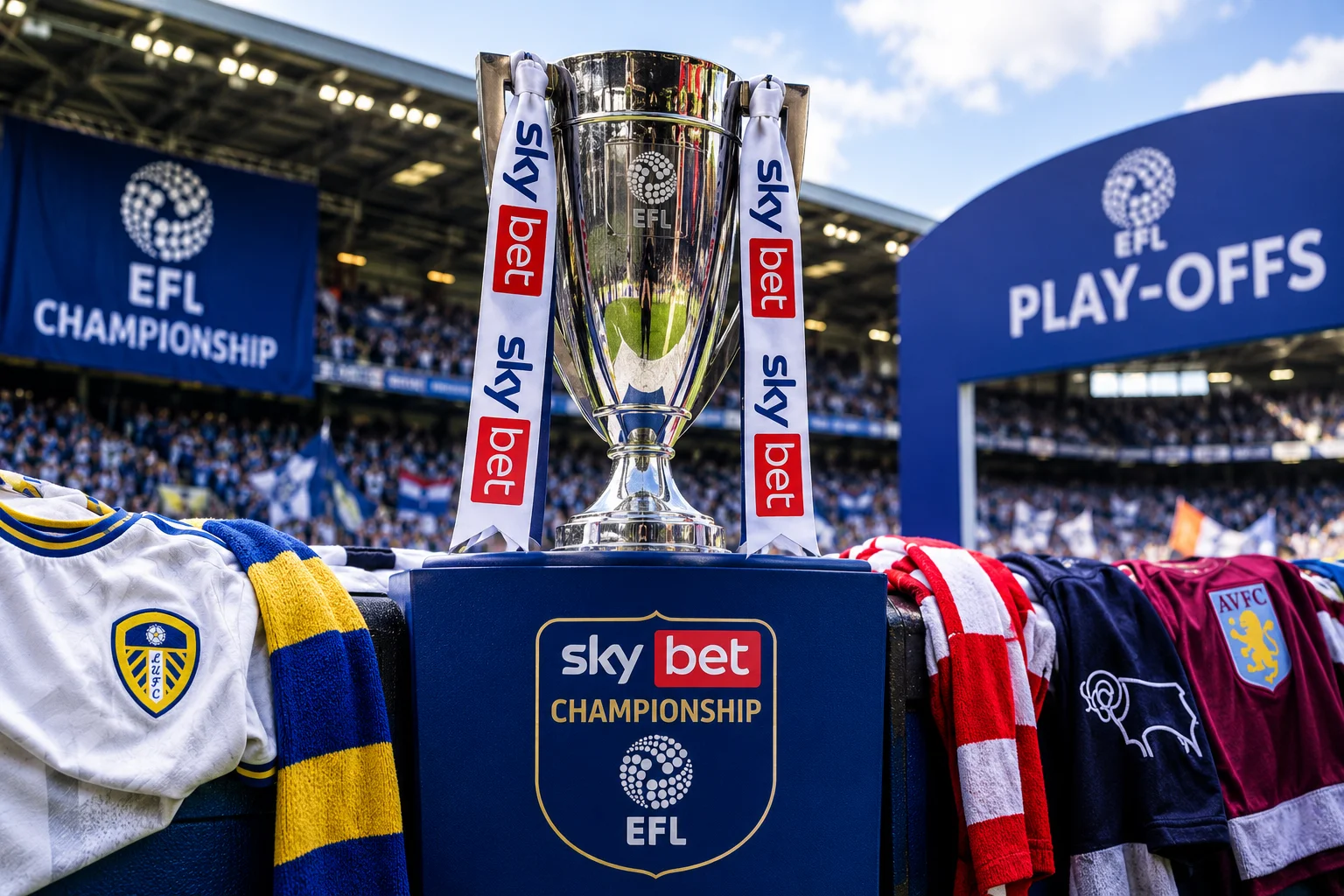
The Championship play-off final is routinely described as the most valuable match in world football, and the description is not hype. A single game at Wembley decides which club joins the Premier League, and the difference in revenue between winning and losing runs into nine figures once parachute payments and broadcast income are counted.
The format itself is simple enough to explain in a paragraph, but the consequences are not, and the thing most people get wrong is assuming the best-placed team usually wins. Over the competition’s history, that has not been reliably true.
The format
The top two clubs in the Championship are promoted automatically. The clubs finishing third, fourth, fifth and sixth enter the play-offs, which are seeded so that third plays sixth and fourth plays fifth.
Each semi-final is played over two legs, with the higher-placed club at home in the second leg. Away goals do not count double, so a tie level after 180 minutes goes to extra time and then penalties. The two winners meet at Wembley in a single match, again with extra time and penalties if needed.
That is the whole structure, and it has been broadly stable since play-offs were introduced to the English game in the late nineteen-eighties. The EFL publishes the regulations in full each season, including the small variations that occasionally apply to the lower divisions.
Where the play-offs came from
Play-offs were introduced to the English league in the late nineteen-eighties, initially as part of a reorganisation that reduced the size of the top division. The original versions were stranger than the current one — in the first seasons a club already in the higher division took part, defending its place against challengers from below.
That format did not last, and by the start of the nineteen-nineties the competition had settled into something close to its present shape, with four clubs from the lower division competing for a single promotion place and the final played at a neutral national stadium. The move to Wembley gave the final the status it now has, and the arrival of Premier League money turned it from a good day out into the most financially significant fixture in the professional game.
The format spread downwards. League One and League Two run their own versions, with the lower division including more clubs because its automatic promotion places are more numerous, and the National League has a play-off of its own feeding into the EFL.
Why the higher seeds lose so often
The advantage of finishing third rather than sixth is real but small. You get the second leg at home, and you face the lowest remaining seed. That is it. There is no bye, no goal advantage, no replay.
Set against that are two disadvantages that are rarely discussed. The first is momentum and mood. A club that finished third has usually just missed automatic promotion, often in the final week, and arrives in the play-offs deflated. A club that finished sixth has usually scrambled in on the last day and arrives delighted to be there. That gap in expectation shows up in performance.
The second is squad fatigue. Teams chasing automatic promotion tend to have leaned hardest on their best eleven through April, while a side that crept into sixth has often rotated more. Three extra high-intensity matches in two weeks punish the squad that is already empty.
Is the second leg at home actually an advantage?
Less than people assume, and in some ways it is a disadvantage. The home side in the second leg knows exactly what it needs, which sounds helpful and in practice produces caution. A team protecting a one-goal lead in front of its own crowd plays deeper than it wants to, invites pressure, and spends the last twenty minutes defending its own box.
The away side, by contrast, has a clear brief and nothing to protect. Over the history of the competition, second-leg home advantage has produced a far smaller edge than it does in ordinary league football, and a significant minority of semi-finals are won by the lower seed.
The third-place problem
One quirk of the format produces a recurring injustice, and it is worth naming. A club can finish third, nine or ten points clear of sixth, and be eliminated by that sixth-placed side over two legs. In a league where third and sixth can be separated by a dozen points, that is a large gap to set aside.
Several alternatives have been proposed over the years: giving the third-placed club a goal advantage, a bye to the final, or home advantage in both legs. None has been adopted, and the reason is commercial rather than sporting. The play-offs work because they are unpredictable, and the broadcast value of four live matches and a Wembley final depends on all four clubs having a real chance.
The clubs themselves tend to accept this, because every one of them has at some point benefited from the format. A side that finished sixth and went up is in no position to argue that sixth should be handicapped.
The final is a different competition
Wembley changes the game, and not only because of the occasion. The pitch is large, which suits technical sides and punishes teams that want to compress space. The crowd is split, so neither side gets a home atmosphere. And the match is one-off, with no second leg to correct a mistake.
The practical effect is to flatten the difference between the two clubs further. Play-off finals are frequently tight, low-scoring and decided by a single moment or a shootout, which is exactly what you would expect from a single match between two sides that finished within a few points of each other.
What is the play-off final actually worth?
The headline figure quoted each year is usually somewhere north of a hundred and fifty million pounds, and it is a reasonable estimate once you include a season of Premier League broadcast revenue, commercial uplift and the parachute payments that follow relegation. For a Championship club, that is transformational money.
It is also why the play-offs distort the division. Clubs build squads to reach sixth rather than to finish third, because the financial reward for sixth-and-promoted dwarfs the reward for third-and-not. And it is why losing finalists sometimes struggle badly the following season, having committed to wages on the assumption of promotion. Once a club does go up, the problem changes shape, and what separates title winners from top-four sides covers what the gap looks like at the other end.
Frequently asked questions
Do away goals count in the Championship play-offs?
No. If the aggregate score is level after both legs, the tie goes to extra time and then penalties.
Who gets home advantage in the semi-finals?
The higher-placed club plays the second leg at home. Third plays sixth and fourth plays fifth.
How often does the highest seed win the play-offs?
Less often than you would expect. The lower seeds have a strong record, largely because the advantage of a better league finish is small and the psychological and fatigue factors work the other way.
Is the play-off final really the richest game in football?
By most estimates, yes, once Premier League broadcast revenue and parachute payments are included. The figure quoted is usually well over a hundred million pounds, which is also why the spending rules matter so much, as profit and sustainability sets out.